The Depleting Missile Defense Interceptor Inventory

Available Downloads

The Issue

The prolific use of missiles and drones in the June 2025 war between Israel and Iran illustrated the growing role of these weapons in modern conflict. The significant expenditure of air and missile defense interceptors, especially by the United States, over the course of the 12-day conflict highlighted both the scarcity and importance of these critical military capabilities. Estimating interceptor inventories presents certain challenges, but examining the available budget data allows for a better contextualization around reported expenditure numbers. This data raises concerns about the inventory of Terminal High Altitude Area Defense (THAAD) interceptors, in particular, suggesting the need to invest in additional capacity. Nevertheless, these investments must be coupled with measures to provide a more sustainable demand signal to industry if the goal is to build a more resilient and responsive industrial base for air and missile defense interceptors. 

Introduction

The prolific use of missiles and drones in recent conflicts has reinforced the growing trend that missiles have become weapons of choice.1 In this security environment, air and missile defenses (AMD)—and the interceptors that they consume—have now become the table stakes for modern conflict. As a result, defense policymakers have munition use rates and inventory concerns at the top of mind. Deputy Secretary of Defense Stephen Feinberg has made missile production a top priority.2 The proliferation and maturation of threat missiles have upped the ante on the number of AMD interceptors required for the United States and other powers to defend their strategic interests.

Ramping up production of interceptors faces more considerable challenges than simply announcing new production targets. Convincing industry to build this capacity will require either additional funding directly from the government or a more stable demand signal than the current budget uncertainty and repeated supplemental funding can provide. Until that production capacity is built, the new U.S. demand will need to be balanced with filling prior orders for foreign customers. Meeting this surge of demand will not happen overnight. The United States either needs to pay the table stakes to build up AMD interceptor capacity or bear the risk of being forced to sit out future conflicts. It now falls to the Department of Defense (DOD) and the industrial base to decide whether that ante will be put down.

The Table Stakes of Modern Conflict

The United States has paid a significant interceptor cost to enter multiple conflicts over the last six months. During the June 2025 conflict, news reports suggest that Iran launched around 550 ballistic missiles at Israel.3 In addition to Israel’s own employment of Arrow and other defenses, the United States reportedly engaged many of the threats with over 150 Terminal High Altitude Area Defense (THAAD) interceptors and approximately 80 Standard Missile-3s (SM-3) during the 12-day war.4

Following those hostilities, the United States also used an undisclosed number of Patriot interceptors in Qatar to defend the Al Udeid Air Base from a choreographed Iranian retaliation to the bombing of its nuclear facilities.5 These attacks came after the United States had already spent about a year defending against Houthi attacks on shipping in the Red Sea, involving the expenditure of about 200 Standard Missile-2 (SM-2) and Standard Missile-6 (SM-6) interceptors.6

Precisely quantifying how these engagements affect the inventory of U.S. air and missile defense interceptors is trickier than it might first appear. Annual procurement data can provide a partial picture of DOD’s buying trends, but does not reflect the inventory available at a given time. The annual defense budget requests include select data on interceptor delivery schedules, which gets closer to a direct inventory estimate, but still requires caveats.7

Top-Level Interceptor Procurement Rates

Annual procurement rates provide a starting point for discussion on the health of interceptor inventories; however, they only show a snapshot of demand for each type of interceptor. With enough years of data, those snapshots can form larger picture of procurement trends for a given missile or class of interceptor. These trends can also give a sense of year-to-year variance in procurement rates, which shows the consistency of demand signals DOD is sending to industry.

Figure 1 shows the annual procurement rates for Patriot PAC-3 Missile Segment Enhanced (MSE), SM-6, SM-3, and THAAD interceptors. These interceptors do not compose the entire U.S. AMD arsenal. In fact, these are among the scarcest assets in that arsenal. The Army’s post–Cold War divestment of short-range air defense caused some capacity issues, but recent years have seen significant growth in inventories of these lower-tier, cheaper, and thus more plentiful interceptors.8 Similarly, the Navy has learned a great deal from its engagements in the Red Sea and is beginning to make investments in cheaper AMD interceptor alternatives.9

Remote Visualization

PAC-3 MSE procurement numbers have been the healthiest among AMD interceptors used in recent engagements. Over the last 10 years (from FY 2015–2024), DOD has procured an average of nearly 270 MSE missiles per year. This data is somewhat skewed by outlier years in 2018, 2019, 2022, and especially 2023. DOD has sent a relatively strong demand signal for PAC-3 MSE interceptors in recent years. Transfers to Ukraine and usage at Al Udeid have likely had only a modest impact on inventory.

As opposed to more flexible missiles like SM-6 and PAC-3 MSE, the procurement rates for ballistic missile defense (BMD) unique interceptors, SM-3 and THAAD, have been relatively lower (see Figure 1). BMD-specific interceptors are the most capable interceptors in the U.S. missile defense arsenal, which both increases unit cost and lengthens production and delivery timelines. 

While the demand coming from political and military leaders for deployments is strong, the demand signal sent to industry by budgets and appropriations is inconsistent.

One challenge is that AMD assets are useful tools for deterrence signaling, both to provide assurance and protection for allies and to deter adversaries. Whenever the United States has a foreign policy problem, it seems like the solution is to deploy an AMD asset. Whether that means extra deployments of Patriot, continuous patrols off Japan in response to North Korean missile testing, or dynamic deployments of THAAD to Israel or Romania, AMD assets have become a major instrument of foreign policy to reassure allies and partners.10 In a sense, the signals are misaligned: While the demand coming from political and military leaders for deployments is strong, the demand signal sent to industry by budgets and appropriations is inconsistent.

Another way to quantify the mixed DOD demand signal is to look at the year-over-year variance in procurement quantities for each of the missiles in Figure 1. SM-3 and THAAD interceptor buy rates have seen significant fluctuations, while SM-6 has had steadier demand (See Figure 2). This consistent demand signal for SM-6 was further bolstered by a multiyear procurement from 2017–2023 for 125 missiles per year.

Remote Visualization

Years of chaotic appropriations processes and budgetary brinksmanship have impacted every federal spending program, with defense programs also feeling the effects of the whiplash. This variance can be positive as well as negative: For example, 2018 saw significant growth in SM-3, THAAD, and Patriot demand and recent supplemental appropriations have further grown MSE stockpiles. However, even positive variance fails to send the sort of consistent demand signal industry would prefer to invest in long-term assets including production facilities or workforce.11 The capital expenditure necessary to accelerate and increase production capacity requires more certain funding than can be provided by continuing resolutions and intermittent supplemental appropriations.

While demand clearly influences missile production capacity, it is not the only factor in determining how many interceptors are currently fielded or could be produced. Better understanding of inventories and production capacity also requires attention to delivery schedule data.
 

Revisiting SM-3 Interceptor Issues

In addition to releasing summary data on the annual president’s budget request, DOD also publishes justification books, which include detailed exhibits for selected procurement programs on previous program performance. Last year, the CSIS Missile Defense Project looked at data from the P-21 exhibits to examine SM-3 inventories and costs following the October 2024 Iranian attacks on Israel.12 Those interceptor expenditures had a limited impact on inventories, mostly due to the low number of interceptors used combined with higher procurement levels in prior years. That article also highlighted the gap between procurement year and delivery, an important consideration for replenishing inventories of more capable interceptors like SM-3 or THAAD. In light of the additional reported SM-3 use in 2025, it makes sense to revisit some of that data and those past conclusions.

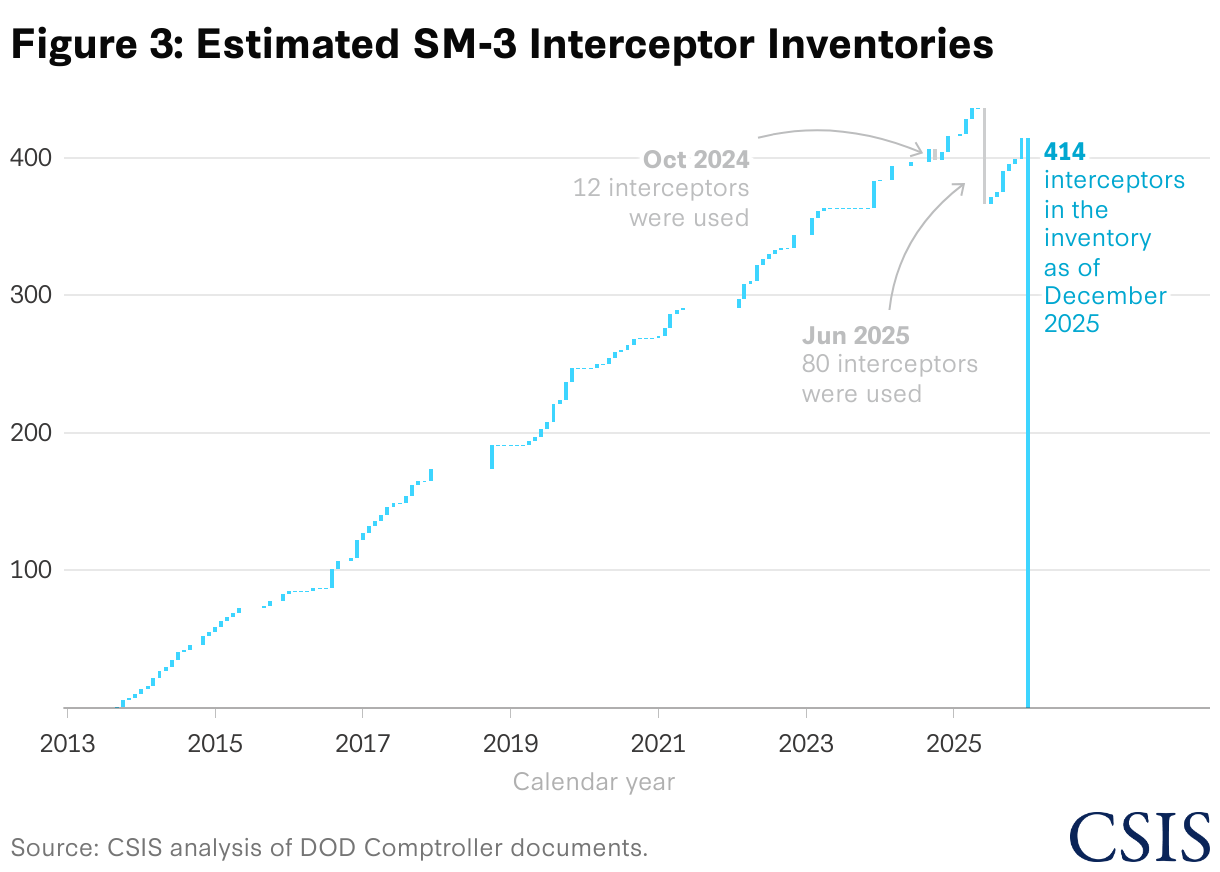
Figure 3 shows the cumulative deliveries of all variants of the SM-3 missile starting with the FY 2011 procurement through the end of calendar year 2025. This data indicates that MDA expects to have received 506 SM-3 interceptors.

The slope of the chart shows how quickly missiles are being delivered, with plateaus showing gaps in missile deliveries while steeper slopes show months where many missiles were delivered. MDA expects to receive 39 new SM-3 interceptors in calendar year 2025, which explains the steeper slope for that year.

Remote Visualization

Figure 3 also includes data depicting the SM-3 expenditures in October 2024 and in June 2025 to provide a sense of the scale of interceptor use compared to missile deliveries. This visually shows how the October 2024 use of 12 interceptors used only a small proportion of delivered interceptors. Adding an estimated 80 interceptors, however, becomes a considerably greater expenditure.

A total of 92 missiles represents about 20 percent of all SM-3 interceptors expected to be delivered to the United States by the end of December 2025. Next year is projected to be another strong year for SM-3 deliveries. The most recent DOD P-21 data shows 66 additional interceptors expected for delivery from January through December 2026.

The biggest problem remains longer-term procurement numbers, a trend continued by the 2026 budget request. Both of the last two budget requests have proposed ending production of the IB variant of the SM-3 in favor of the IIA variant, sacrificing capacity for capability.13 While this decision might reflect the need for the greater range of the SM-3 IIA to deal with threats in the Indo-Pacific, it has constrained MDA’s ability to replace interceptors used in other theaters.

It seems this uncertainty has caused the unit costs of SM-3 IB interceptors to rise as well, going from around $9 million per missile for the FY 2021 procurement all the way to nearly $24 million per missile for the FY 2024 supplemental missiles.14 This is likely an extreme example of cost growth, but it highlights how the uncertainty of supplemental funding can ripple through the supply chain, causing delivery delays and higher prices.
 

The THAAD Problem

The THAAD expenditures over the summer of 2025 are more concerning. Delivery data suggests that the THAAD production lines have delivered a roughly similar number of interceptors compared to those of the SM-3, however, the reporting suggests a greater rate of fire of THAAD interceptors. The Missile Defense Agency (MDA) received a total of 534 interceptors according to the most recent DOD P-21 procurement data (Figure 4). This analysis excludes 50 THAAD interceptors purchased from research, development, test, and evaluation (RDT&E) accounts because many of those interceptors are likely either early prototypes that have been phased out of the inventory or have been used for testing.15

Remote Visualization

This estimate of 534 THAAD interceptors differs from other public estimates of the THAAD inventory due to the gap between procured and delivered interceptors. As in Figure 3, the slope of Figure 4 shows the monthly rate of delivery for THAAD interceptors. There is steady and relatively rapid growth of the inventory between 2020 and 2023, but the plateau at the top suggests there has not been a new THAAD interceptor delivery to the U.S. inventory since July 2023. The steeper slope comes in part from the stronger procurement years in FY 2018 and FY 2019, in which MDA bought over 100 interceptors.

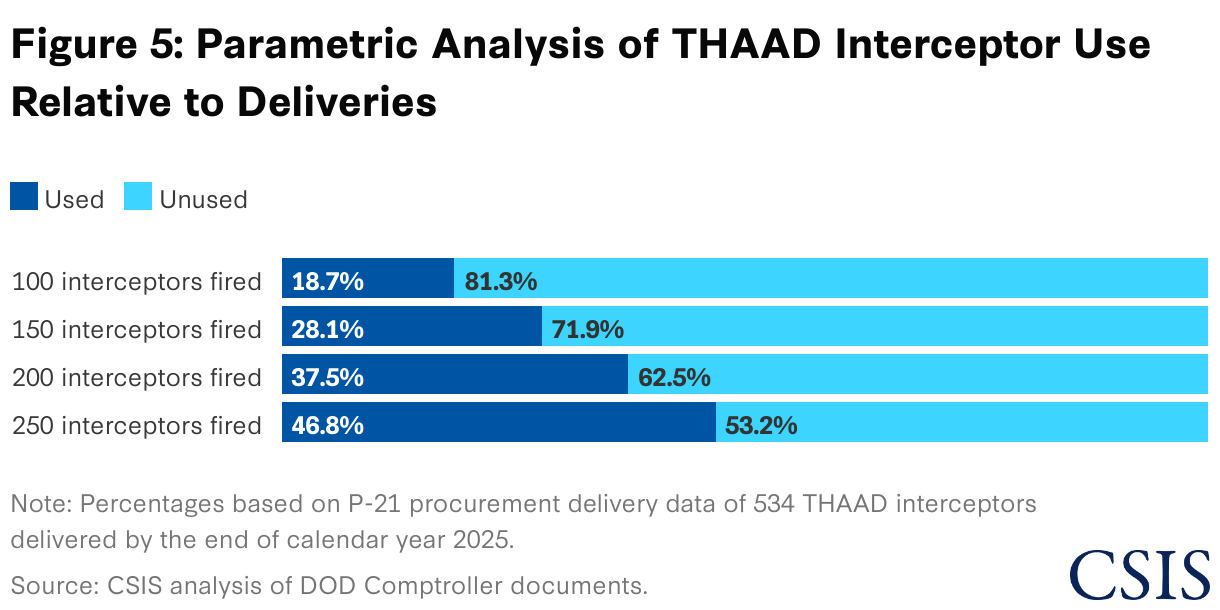
While uncertainties thwart a precise calculation, one can nevertheless parametrically analyze how different use rates would affect the interceptor inventory, using deliveries as the baseline. The most optimistic estimates of June 2025 THAAD interceptor usage have been around 100 interceptors.16 On the other hand, the larger reported estimate of “more than 150” from the Wall Street Journal suggests a need to assess some potentially higher estimates.17 For example, the effect of firing between 100 and 250 THAAD interceptors would deplete the inventory by between 20 and 50 percent (see Figure 5).

Remote Visualization

The effect of this expenditure is more acute in light of force structure considerations, specifically reload rates. The United States has fielded eight THAAD batteries, each with six launchers and eight interceptors per launcher, or 48 interceptors per battery.18 Under this assumption, that would mean that 384 of the previously delivered THAAD interceptors were assigned to fielded THAAD launchers, which would leave 150 for reload and spare capacity. 

If two batteries were deployed, they would be able to fire 96 interceptors before needing to reload. This would line up with the most optimistic estimates of THAAD use of about 100 interceptors. If the reported number of 150 interceptors used is correct, that would mean using about 54 additional interceptors from the reload stockpile, about a third of the inventory previously unassigned to a launcher. That would also leave only 96 interceptors to restock the two batteries, which would leave the force without any reserve interceptors. If 200 interceptors were fired, that would leave the United States short an entire battery’s worth of interceptors, as that would mean 104 interceptors fired from reloads and only 46 in the stockpile to replenish the original batteries. 

DOD has taken some steps to restock THAAD interceptor inventories since June 2025, but continued budgetary uncertainty will hinder execution and longer-term solutions. In May and June, DOD reprogrammed over $700 million into the FY 2025 THAAD procurement program from previously approved Israel Security Supplemental Act funds.19 Based on the FY 2026 estimated unit cost of $15 million per interceptor, this would be enough funding to buy about 45 additional missiles.20 In its FY 2026 request, MDA programmed funding for 25 interceptors in its base budget request and an additional 12 interceptors using funds from the reconciliation bill. The continued negotiations over DOD flexibility to use reconciliation bill funding create further uncertainty about these appropriations.21 While this funding provides a start, it still falls short of replacing even the most optimistic assessments of THAAD expenditures.

Replacing those interceptors will also have to contend with limits to THAAD production capacity. Figure 6 shows another way to look at the P-21 data with each color representing a different procurement fiscal year. This shows that the gap in new U.S. deliveries starts with the last FY 2020 procurement interceptors. As of the June 2025 budget release, this gap is not slated to end until April 2027 when MDA will receive interceptors that it obligated procurement funds for in FY 2021. Counting only the FY 2021–FY 2024 interceptors, MDA has a pipeline of 100 procured missiles yet to be delivered.

Remote Visualization

This gap between U.S. deliveries does not mean the production line is cold. In fact, industry announced the delivery of its 900th THAAD interceptor in January 2025.22 Rather, it would appear that U.S. inventory met a particular level, and production shifted to foreign orders. The 2017 THAAD sale to Saudi Arabia included 360 interceptors in support of their fielding their first operational battery in July 2025.23 Moves to pull forward U.S. THAAD deliveries before additional production capacity can be built could compete with international orders. 

Balancing timely delivery of foreign sales and additional demand from DOD presents another potential capacity constraint on replacing expended interceptors. Simply prioritizing U.S. interceptors and pushing those procurements to the front of the production line risks undercutting future international sales by creating uncertainty about previously agreed delivery schedules. Some of this risk is probably baked into ally and partner decisions to buy from foreign suppliers. Nevertheless, the more often the U.S. jumps the production line, the likelier it is that allies and partners will search for alternative suppliers.

Continued reliance on supplemental funding for interceptor procurement, combined with the overall uncertainty surrounding the defense budget, presents a significant challenge.

Beyond the immediate challenge of replacing used interceptors, DOD needs to consider how it can support a more responsive and resilient industrial base for air and missile defense interceptors. Continued reliance on supplemental funding for interceptor procurement, combined with the overall uncertainty surrounding the defense budget, presents a significant challenge. Appropriation delays have significant effects on small businesses that make up the base of interceptor supply chains.24

While larger companies can better weather the financial implications, the inconsistent demand signals sent by these budgetary mechanisms disincentivize investment in the sort of capital projects required to accelerate and ramp up production. If that capacity will only be used when there is sufficient reason for a supplemental appropriation, defense firms may not have enough confidence to invest in additional production facilities or long-term workforce.

Even with additional capacity and funding, the long lead times associated with sophisticated air and missile defense interceptors such as THAAD and SM-3 suggest a need to reevaluate overall missile inventory requirements. DOD could codify additional munitions requirements, including the need for larger stockpiles of replacement interceptors, through the DOD Munitions Requirement Process, which establishes the total munitions requirement.25

The Iran-Israel conflict provides new data on the munition expenditure rates of modern conflicts, a lesson reinforced by operations in Ukraine. These conflicts provide new data on which to update inventory requirements. To account for the lead times associated with sophisticated interceptors, total munitions requirements should build more slack into their calculations of necessary reserve inventory. This would also produce a more durable demand signal for industry, as filling those requirements would require sustained investment over time.

The U.S. Army’s decision to increase its objectives for Patriot PAC-3 MSE interceptor procurement from 3,376 to 13,773 total missiles provides an example of one mechanism to send this demand signal.26 Considering the high deployment rate of air and missile defense assets, it is clear that these munitions requirements should account for not only the number of missiles required for the primary pacing challenge, but also additional missiles for use in contingency deployments. While funding to meet this requirement would still remain subject to annual appropriations, these changes would signal a long-term support for the need to buy interceptors. These requirements would codify the demand signal to industry and help budgetary decisions within the department by making the risks of low interceptor procurement levels more explicit.
 

Anteing Up

As missiles have become weapons of choice, missile defenses have become the table stakes of modern conflict. The recent THAAD, MSE, and SM-3 employment in the Middle East shows that current inventories and production rates of missile defense interceptors are insufficient. Their employment in unexpected conflicts should be planned for, rather than come as a surprise that disrupts the inventory and prompts considerable course corrections. If every use of a U.S. air and missile defense interceptor is going to produce another round of discourse about inventories, then it is time to reevaluate either the deployments themselves or how to procure enough interceptors to avoid handwringing.

There will continue to be strong demand from U.S. combatant commanders for air and missile defense assets to reassure allies and partners and deter adversaries. With the proliferation of missile threats around the globe, air and missile defense assets are likely the table stakes for entry into the theater of future conflicts. The Department of Defense can either ante up and buy the necessary interceptors to support those deployments, or fold on its regional interests and bear the consequences.

Please consult the PDF for references.

Wes Rumbaugh is a fellow in the Missile Defense Project at the Center for Strategic and International Studies (CSIS) in Washington, D.C.

This report is made possible by general support to CSIS. No direct sponsorship contributed to this report.